Within the high-stakes arena of contemporary professional sliding, success is far more than exclusively a product of sheer torque or behind-the-wheel aggression. Conversely, it has become a intricate science that requires a scrupulous blend of picking a time-tested car, equipping it with the most precise competition parts, and, most essentially, comprehending its dynamic characteristics on the circuit through advanced vehicle dynamics analysis tools. This comprehensive guide functions as your blueprint from the initial concept of a project car right through to the final telemetry-optimized refinements that elevate a strong vehicle into a consistent podium finisher. We will examine in detail the methodical process of vehicle alignment optimization, showing how a advanced drift tuning app like precise measurement hardware eradicates approximation and offers exceptional visibility into your car's actual performance.
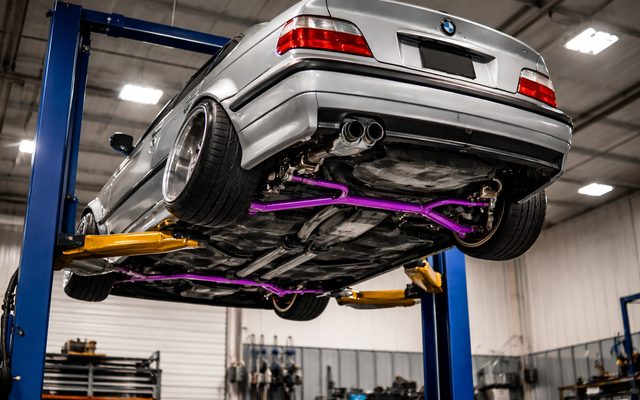
The bedrock of any successful competitive sliding vehicle is, indisputably, the platform itself. Certain platforms have attained iconic standing within the worldwide drifting culture due to their inherent handling characteristics, strong design, and the immense ecosystem of specialist parts available. Picking the right starting point is the first and most significant choice a driver will make. As an example, the BMW E36 is commonly accepted as one of the best balanced drift platforms of history. Its excellent balanced front-to-rear weight, combined with a driven rear axle setup and robust six-cylinder powerplants, establishes a platform that is both forgiving for beginners and highly capable in the hands of a professional competitor. The next step of this philosophy, the E46 model BMW, improves on these strengths with a more developed frame, wider track for improved stability, and even more steering angle as standard from the manufacturer. A different formidable platform in the pro scene is the Chevrolet Corvette C6.
This American sports car offers a particular combination of advantages to the drifting world, including a lightweight aluminum structure, a backwards-positioned transaxle that aids in an ideal balance, and the colossal thrust of a large-displacement GM LS engine. This blend transforms it into an utter monster on track, capable of initiating and holding long drifts with relatively effortless deployment of acceleration. For builders seeking exceptional value, the 350Z model Nissan rises above as a top-tier candidate. It comes from the factory with a robust platform, a effective OEM LSD, and the responsive V6 engine that delivers sufficient power and torque for learning and moving up in the sport. Its successor, the Nissan 370Z, brings more improvements in chassis stiffness, suspension design, and outright engine performance, solidifying its status as a popular selection among professional drivers. Additional historic platforms that deserve consideration encompass the lightweight Wankel-engined FC generation RX-7, the most popular Nissan S13 240SX, the V8-powered Ford Mustang SN95, the modern E90 3 Series, and the compact yet unbelievably playful and teachable Mazda MX-5. All of these cars gives a distinct palette of traits, complexities, and capabilities, but they all possess the fundamental ingredients necessary to become a capable sliding vehicle.
However, choosing the optimal platform is merely the starting point. To access the complete performance of any of these machines, significant upgrades to the steering geometry and suspension systems are utterly non-negotiable. This is where the world of performance drift-spec parts becomes critical focus. The one most transformative modification for a serious drift machine is the fitting of a drift-spec angle modification kit. These engineered assemblies, like those engineered by performance brands like SLR, are designed to radically enhance the vehicle's available turning lock. A factory street car is highly limited in how far its tires can rotate, a safety limitation for public road operation. In oversteer driving, conversely, aggressive steering input is continuously needed to manage and sustain a angle. An angle kit substitutes the OEM uprights, tie rods, and sometimes suspension arms with parts that allow the wheels to attain degrees of turn beyond 70 or even 80 degs, compared to a average factory limit of around 40 to 50 °.
This tremendously greater capability offers the driver with significantly more authority during a slide, allowing it to be much more straightforward to begin a slide, hold it through a long turn, and change seamlessly from one angle to the opposite. The improvement in handling is absolutely transformative. Combined with a properly specified modification is the every bit as essential modification to the vehicle's damping system. Generic or even high-end sport dampers are generally not intended for the specific and extreme demands of drifting. A drift-spec pair of suspension units is crucial. These specialized dampers incorporate specific piston tuning and spring stiffness that are optimized for the extreme mass transition that is characteristic of sliding. When a operator begins a angle, the vehicle's mass is shifted forcefully to the outside of the corner. Correct competition suspension handle this transfer in a controllable fashion, permitting the chassis to find its balance quickly and providing the pilot clear feel through the steering wheel and seat. They also provide accurate tuning of stance, shock absorber rate, and corner weighting, which are all key aspects of fine-tuning the car's behavior to a given track or piloting approach. Together, a top-tier steering angle kit and a expertly specified pair of performance coilovers constitute the absolute physical base upon which all future optimization is built.
Once the core hardware is in place, the following essential step in the project is the detailed adjustment of the car's suspension geometry. This is the world of car suspension tuning, a methodology that can feel daunting to the beginner but is, in fact, the defining factor to converting a collection of capable components into a cohesive and consistent machine. The most debated aspect of alignment for oversteer is certainly negative camber. Camber angle is the inclination of the tire in relation to the vertical plane when observed from the front-on of the vehicle. If the top of the tire is angled inward, this is referred to as inward tilt. For sliding, inward-leaning wheels on the front axle tires is generally employed and is considered critical. The logic is fundamentally linked to tire contact.
When a car is going around a bend at extreme slip angles, the frame tilts toward the outside of the turn. This lean causes the outside steering tire to lose its ideal contact patch with the asphalt. By adding negative camber, the wheel is pre-tilted to counteract this lean. As the vehicle leans into the corner, the tire gains a better contact patch with the road surface, increasing its traction at the precise moment when it is absolutely essential for steering authority. Usually, front axle angles for a dedicated drift car range from approximately -3 degrees to as much as -5 degrees or even greater, depending on the parameters of the car setup, rubber choice, and pilot preference. The rear tires also use inward tilt, but the angles are usually more conservative and more nuanced than the front. Overly aggressive negative camber at the rear can cause the vehicle to extremely loose and challenging to predict on throttle input, as it reduces the available tire footprint of the driven wheels during forward throttle application. Therefore, rear axle angles are frequently in the ballpark of -1 degree to -3 degrees, finding a delicate compromise between offering sufficient cornering bite to aid in entering and holding the slide while also keeping usable hook-up for exiting the bend. alignment is just one element of the larger tuning puzzle, which also involves toe, self-centering steering, and steer correction adjustment.
Toe describes the direction of the wheels as seen from above. Toe-in means the front edges of the wheels are nearer together than the rear edges, while outward toe means the converse. For sliding, a slight amount of front toe out is commonly employed to improve the initial steering response, making the vehicle feel more agile and eager to begin a slide. Rear axle toe angle is generally set to neutral or a extremely slight amount of toe-in to foster predictability under acceleration. self-centering is the longitudinal or aft tilt of the kingpin axis when viewed from the lateral of the car. More caster angle increases self-centering and stability confidence, and it additionally adds to inward lean effect during steering, which is very advantageous. Adjusting these values is a complex interaction where a modification to a single parameter can and will impact the others. The conventional process for setting a car's alignment for drifting has historically been a tedious affair of experimentation and feeling. A tuner or team would introduce a change based on intuition, drive the vehicle on track, use the operator's individual feel and feedback, and then make another tweak. This cycle would repeat again and again until the vehicle felt "good" or the available practice session ran out. This approach is not only extremely slow in terms of hours and costs, but it is also fundamentally imprecise.
Pilot perception is a notoriously unreliable data source, influenced by many factors such as tiredness, changing track surfaces, weather, and just the focus of the pilot on that specific run. What feels "oversteery" on one pass might feel "tight" on the next run, leading to contradictory information and frustrating tweaks. This age-old challenge in vehicle dynamics optimization is specifically where modern telemetry systems has stepped in to revolutionize the process.
The rise and application of advanced vehicle dynamics tools has ushered in a radically different era for engineering and refining professional drift cars. These platforms, showcased by groundbreaking solutions like GripDial, function by directly measuring the live physical performance of the vehicle as it is being driven on the circuit. As opposed to using personal impression, these devices collect objective data on essential parameters such as shock absorber movement, corner velocities, lateral and longitudinal g-forces, wheel angle, and accelerator and brake pedal position. This acquired data stream is then processed by sophisticated applications that can visualize and decode the data in a comprehensible manner. For the very first time, tuners and teams can observe precisely what the car is exhibiting at each moment of a lap. This function transforms the complete suspension tuning process. Consider the aforementioned challenge of optimizing the front negative camber for a specific coilover setup tips car. As an alternative to applying a adjustment from -3 degrees to -3.5 degrees and then running many passes to try and "feel" a difference, a suspension tuning tool can deliver immediate and irrefutable information. The tool can display visually how the tire's contact patch is behaving during the key moments of a drift tuning app slide: initiation, holding the angle, and switch. It can reveal if the existing camber setting is allowing the steering tire to keep ideal contact or if the compound is over-stressed on its outside shoulder.
The software can after analysis make fact-based suggestions for adjustment. Perhaps the telemetry indicates that the outside front tire is even overloading its sidewall at -3.5 degrees of negative camber, suggesting that an increase to angle, say -4 degrees, might be advantageous. Alternatively, the information might show that the tread is failing to achieving heat or that the inside edge is wearing excessively, which could suggest that there is too much angle and a modest lessening back to -3.2 degrees would be more efficient. This degree of accuracy and practical insight was completely impossible in the era of exclusively manual setup.
The impact of using a comprehensive suspension tuning tool extends much further than just optimizing camber. It becomes an priceless coilover setup tips that is customized to your exact chassis. When adjusting the shock absorber clickers on your suspension, rather than depending on general tips or replicating another car's settings, you can utilize the software to see how the car is performing in relation to your adjustments. The application can graph the wheel movement data over a section of track, revealing if the coilovers are controlling the body movement optimally or if they are permitting the vehicle to bounce uncontrollably after a direction change. It can help in pinpointing challenges like bottoming out or losing droop, permitting you to make data-backed choices to helper springs, rebound/compression values, or stance. This process translates similarly to the detailed art of suspension geometry optimization. In addition to camber angle, the software can give analysis into how modifications to toe and caster are affecting the chassis's stability during specific phases of a drift. For example, it can allow you to ascertain the ideal amount of front axle negative toe for your particular steering geometry and piloting style by measuring the speed of turn-in reaction and the consistency of the chassis at maximum steering angle. This turns the system an incredibly powerful performance optimization handbook that is constantly calibrated by the live behavior of your own vehicle on the track. It elevates the entire endeavor from a dark art into a repeatable optimization exercise.
Additionally, the value of a system like GripDial is not restricted to expert tuners with vast resources. For the amateur enthusiast, it serves as an powerful educational tool. It effectively provides the builder with the insight of a drift suspension tuning guide professional race engineer without needing the corresponding expense. It speeds up the tuning process by giving unambiguous answers to questions that would normally take seasons of trial and error to understand. A tuner can understand how their specific chassis reacts to different settings, developing a deeper understanding of suspension theory in the process. It furthermore makes accessible high-level chassis dynamics techniques, enabling anyone with the drive to optimize their vehicle to do so in a systematic and effective way. This is particularly valuable in a activity like sliding, where engineering expertise has historically been a highly secretive advantage among top teams. Now, that capability can be in the toolkit of any dedicated builder.
In the final analysis, the process to constructing and tuning the ideal competitive drift car is a multi-stage endeavor that perfectly integrates proven hardware wisdom with 21st-century data solutions. It starts with the wise selection of a proven car, then built upon the application of non-negotiable competition parts like high-performance drift angle kits and properly specified drift-spec adjustable dampers. The build then advances into the precision realm of car suspension tuning, where values like camber angle, toe setting, and caster angle are meticulously adjusted to match the car's new geometry and the pilot's personal needs. The final step, and what really separates the contemporary approach from the past, is the adoption of a advanced suspension tuning application. This tool removes the guesswork and inefficiency of purely seat-of-the-pants adjustment by delivering empirical, real-time telemetry on how the car is actually performing. It serves as an incredible diagnostic aid, a comprehensive drift suspension tuning guide, and a all-in-one chassis development system. Together, this integrated methodology ensures that all component of the drift car—from the choice of the chassis to the final adjustment on the coilover—is perfected for peak performance on the competition venue. It signifies the full maturation of the sport of drifting, connecting mechanical driving skill with precise vehicle setup to create the most competitive vehicles possible.